About
Giuseppe Aceto
Objects, scenarios, and software for discussing technology.
A humanities background, then years in digital design. Today I work between Milan and Zurich on objects, scenarios, and software — where technology can still be discussed, not only used. In Italy that tension has older roots in radical design.
Relatronica is a speculative-design laboratory in Switzerland. Welt Form is infrastructure for verifying automated outputs before they become decisions. At CERN I published the Toolbox for Ethical Futures: open exercises for critical thought about technology, in a group.
I care about keeping verification open: what a system presents as certain must remain refuseable. Free software makes readable what would otherwise stay a black box.
I work with laboratories, institutions, and communities — consulting, workshops, talks, and public writing. I mentor with the University of Padua, the University of Trento, and ADPList.
Roots
Radical design in Italy
Before English-language critical design, Florence in the 1960s and 1970s: groups using design to criticise consumption, the city, and design education itself.
Superstudio and Archizoom drew endless cities and catalogues of absurd objects — not to manufacture them, but to show where market logic leads. With No-Stop City, Archizoom imagined urban territory as a continuous field, without centre or edge.
Ugo La Pietra, in Dissociation as a mode of action (1976), described individuals caught between home and a controlled metropolis. Enzo Mari, in Autoprogettazione (1974), moved design into the user's hands: printed instructions, not chairs off a production line.
Global Tools (1973–1975) tried to turn design into a shared laboratory — among Branzi, Mendini, Ettore Sottsass, and others. Dunne & Raby often cited that period as an ancestor of their work at the RCA. I use it today to read platforms, AI, and infrastructure with the same clarity.
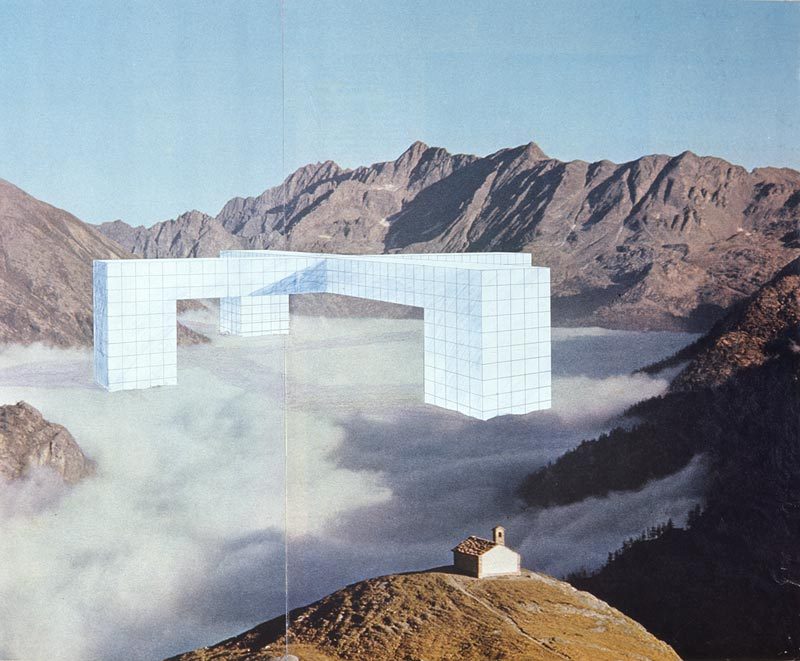
The Continuous Monument
Photomontage, 1969: an endless white grid invades the valley. Superstudio imagines architecture as totality — a critique of homogenisation, not a building to erect.
Get in touch
Talks, workshops, research, and consulting. I work with laboratories, institutions, and teams on verification, speculation, and free software.
Milan / Zurich